Free guide from AsanReview
How Google Maps ranking works
Why is a competitor above you on Maps? Google explains its local ranking in three words. Here is what they mean in practice.
Updated 19 November 2026Free plan, no cardJazzCash · EasypaisaRoman Urdu · Urdu · English
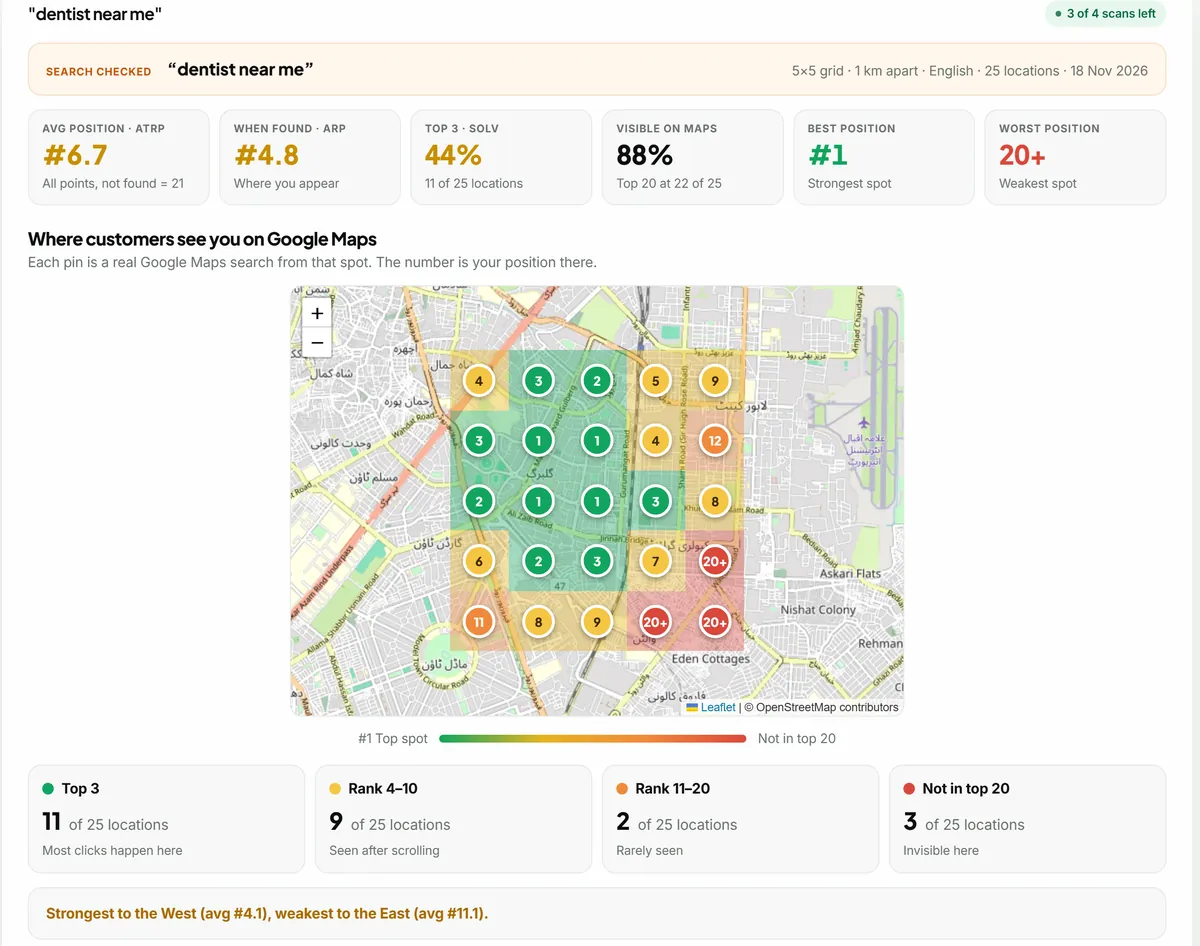
Google ranks local results mainly by three factors: relevance (how well the profile matches the search), distance (how far the business is from the searcher or the place named in the search) and prominence (how well known the business is, including the number of Google reviews and the rating). Because distance matters, your position is different at every location.
Relevance
Complete your Google Business Profile: correct primary category, services, opening hours, description and photos. The words customers use in reviews and the services you list help Google match searches to you.
Distance
You cannot change where you are, but you can see how far your visibility reaches. A business often ranks in the top 3 nearby and disappears two kilometres away.
Prominence
Google states that review count and review score factor into local ranking, along with information about the business from across the web. A steady flow of new reviews, with replies, is the part of prominence an owner can work on every day.
Measure it with a rank grid
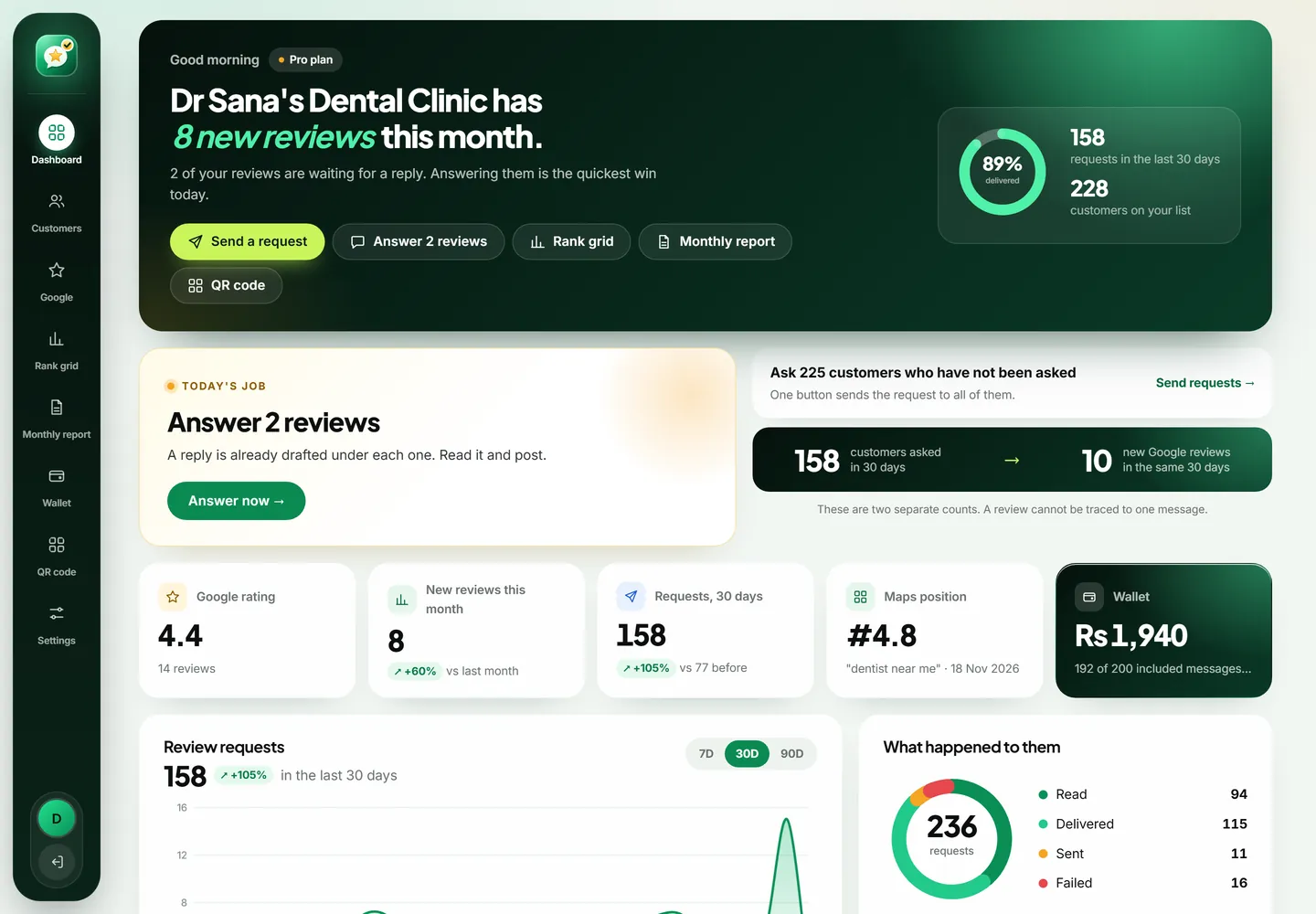
A rank grid searches your keyword from a grid of points around you and shows your position at each. It tells you which side of the area is weak and which competitors are winning there, so you know where to focus.
First, what "ranking on Maps" actually means
When someone searches for a kind of business, Google shows a map with three results beneath it, often called the map pack or local pack, and a longer list behind "More places". Appearing in those first three is what most owners mean by ranking. Below the third position the number of people who see you falls sharply, and beyond the first twenty you are, for practical purposes, not in the search at all.
There is no single list. Google builds a fresh one for every search, based on what was typed and where the person is.
Relevance: does Google know what you do?
Relevance is how well your profile matches the search. The strongest signal you control is your primary category. A clinic listed as "Medical clinic" when it should be "Dermatologist" will struggle for skin-related searches no matter how many reviews it has.
After the category come the details: additional categories, the services you list, your business description, your products, and the words customers use in reviews. Fill in everything Google offers. Empty sections are missed chances to tell Google what you should appear for.
Distance: the factor you cannot argue with
Google prefers businesses close to the searcher, or close to the place named in the search. Someone in Johar Town searching "bakery near me" is shown Johar Town bakeries first. You cannot move your shop, and you should never use a false address to appear somewhere else; that breaks Google's rules and gets profiles suspended.
What you can do is extend how far your visibility reaches. A business with strong prominence keeps appearing further from its door than a weak one. That reach is exactly what a rank grid measures.
Prominence: how well known you are
Prominence is Google's estimate of how established and trusted a business is. Google says it draws on information from across the web, and that review count and review score are part of it: more reviews and positive ratings can improve local ranking.
For an owner this is the encouraging part, because it responds to effort. You cannot change your location and you set your category once. Reviews, though, can grow every week for as long as you keep asking.
A checklist for your profile
- Correct primary category, plus any additional categories that truly apply.
- Name exactly as on your signboard. Do not stuff keywords or city names into it; that is against Google's guidelines.
- Accurate address and a pin in the right place.
- Opening hours, including Friday and holiday hours.
- Phone number that someone answers.
- Services or menu filled in.
- Real photos of the outside, inside, products and team.
- A steady flow of reviews, each with a reply.
Myths worth dropping
- "Putting keywords in the business name is a smart trick." It is a violation, and competitors report it.
- "More categories is always better." Irrelevant categories dilute what you are known for.
- "I can pay Google to rank higher on Maps." You cannot. Ads are a separate, labelled product.
- "Reviews from anywhere help." Reviews should come from real customers; fake ones are removed and can bring penalties.
- "Ranking is the same for everyone." It changes with the searcher's location, which is the whole reason grids exist.
How to read a rank grid
Imagine a 5 × 5 grid of points around your business, 1 km apart. At each point a search is made and your position noted. Green pins near the centre fading to red at the edges is the normal shape: strong at home, weaker with distance. The interesting cases are the exceptions. A red patch on one side usually means a strong competitor sits there. A green arm stretching in one direction often follows a main road.
Watch three numbers over time: average position across all points, the share of points where you are in the top 3, and the share where you appear at all. When those improve from one month to the next, what you are doing is working.
What to do when a competitor is above you
- Open their profile and compare categories. If their primary category is more precise than yours, fix yours.
- Compare review counts and how recent the reviews are. If they have many more, asking every customer is your first job.
- Compare photos. Add real ones if you have few.
- Check that your hours, phone and services are complete.
- Scan again in three to four weeks and see what moved.
Patience, and a way to measure it
Local ranking moves gradually. A week of effort will not show; a few months of steady reviews and a complete profile usually will. The danger is giving up in week three because nothing seems to be happening. Measuring with a grid every few weeks protects you from that, because small gains at the edges of the map show up in the numbers long before you would notice them yourself.
Questions people ask
Can I pay Google to rank higher on Maps?
No. Google says there is no way to request or pay for a better local ranking. Ads are separate and marked as ads.
How long until more reviews change my position?
There is no fixed time. Expect gradual movement over weeks, and measure with a scan every two to four weeks.